More about movement types
Movement can be divided into three main types:
- Cardio (energetic, aerobic, puffy panty) exercise that makes your heart beat faster and your breathing quicker.
- Strength exercise that works your muscles against gravity or another resistance.
- Balance exercise that helps you stay steady and coordinated.
All three types of movement are important, so it’s a good idea to include them somewhere in your week.
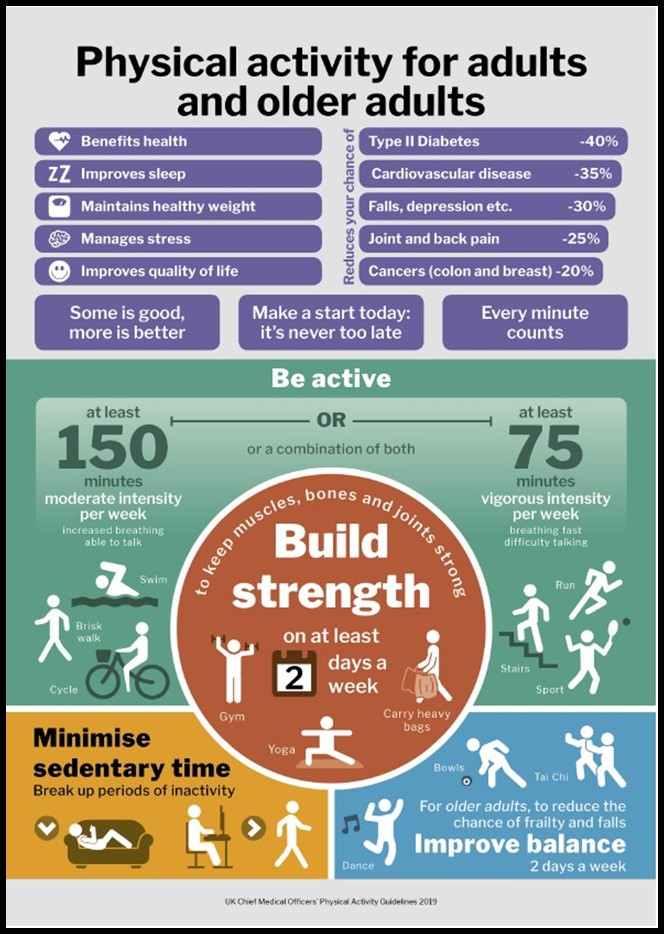
The Chief Medical Officer highlighted how important all these types of movement are in guidelines published in 2019. It is intended that you build up gradually towards these levels, from where you are now.
Figure 1: Chief Medical Officer guidelines for physical activity in older adults 2019
_________________________________
Cardio (aerobic, energetic, puffy panty) exercise
What is cardio (energetic, aerobic, puffy panty) activity?
Cardio activity makes you breathe deeper and faster. This helps your body get rid of waste from the exercise and take in more oxygen.
Pay attention to how this makes you feel. It might seem like you’re breathing harder to get more air in, but really, you’re breathing harder to push more air out. That’s how your body clears out the waste made during exercise.
Your heart beats more strongly and your heart rate goes up. You may become more aware of your heart beating. This is completely normal.
Your cardiorespiratory fitness is how well the heart, lungs, blood vessels and muscles can work together to use oxygen and clear waste products. The higher your cardiorespiratory fitness, the lower your risk of death from any cause. Doing cardio activity is one of the best ways to make your heart and lungs stronger and improve your fitness.
What is the evidence that building cardiorespiratory fitness works?
There have been many studies, conducted over the last 8 decades which unequivocally show that people who have higher cardiorespiratory fitness, have the lowest risk of death from all causes.
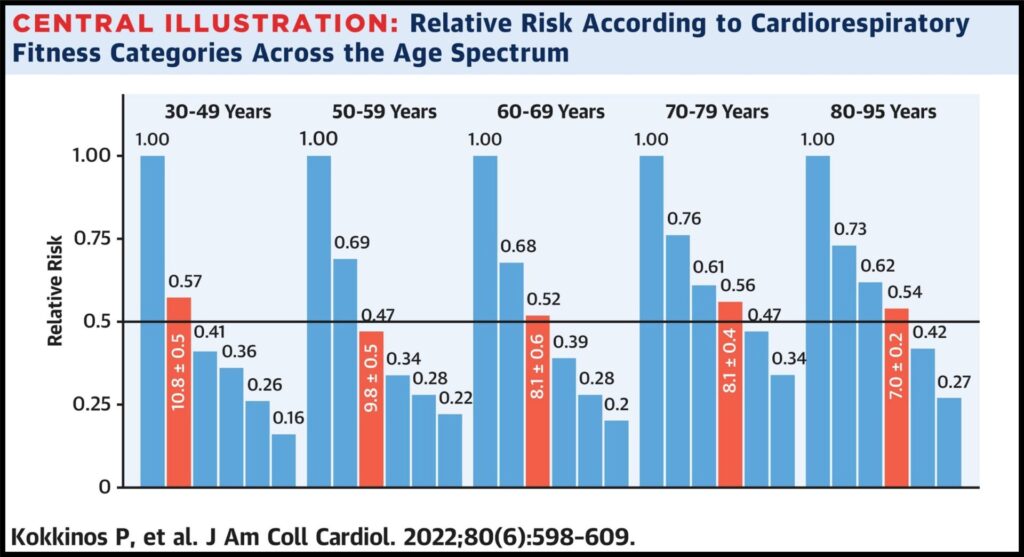
For example: the graph below, taken from a recent trial of 750,000 Americans shows how cardiorespiratory fitness, measured through exercise testing on a treadmill, affects relative risk of death from all causes across the ages.
Figure 2: Relative risk of death from all causes according to Cardiorespiratory fitness across the ages
Source: Kokkinos P, et al. J Am Coll Cardiol. 2022;80(6): 598-609.
Explanation: Within each age group, the bars from left to right show different levels of cardiorespiratory fitness. These levels are based on how people scored in age-specific percentiles of peak METs (a measure of how much energy the body uses during exercise). The bars on the left of each age group represent the least fit (with participants using the most energy for the same exercise) and the bars on the right of each age group are the most fit (with participants using the least energy for the same amount of exercise. The numbers shown above each bar represent the hazard ratios, which indicate the risk of death for each cardiorespiratory fitness level within that age group. The red bars highlight the cardiorespiratory fitness level and peak METs value linked to about a 50% lower risk of death compared with the lowest fitness level. So, the higher your cardiorespiratory fitness, the lower your risk of death from all causes. The study concluded that people meeting the guidelines of more than 150 minutes per week of moderate intensity cardio activity will on average live longer than those who don’t. For example, a 70 year old meeting the guidelines, would expect to live at least 2.7 years longer than sedentary individuals of the same age.
How does cardio activity work?
1. Regular activity strengthens all our muscles, including the heart muscle and the muscles that support our lungs. Remember the heart is a muscle, so it too needs to keep strong. Asking it to pump more often and more powerfully will increase its strength.
2. Cardio exercise also protects the body from long-term, low-level inflammation. This type of inflammation is linked to serious conditions such as heart disease, cancer, certain types of dementia, arthritis and many other illnesses. Exercise can help to reverse it.
How hard should I be working?
With cardio activity, you can work as hard as you feel able. From gently increasing your heart rate and breathing (light-moderate intensity) to your maximum exertion (very vigorous intensity) where you may only be able to speak a few words at a time. You can change the intensity by moving faster or putting more effort into the activity. It is very important, however, that individuals build up gradually, especially to more intense activity as there is an increased risk of adverse events in people undertaking unaccustomed vigorous activity. Always start at a comfortable level and build gradually.
How hard you are working relates to what percentage of your ‘VO2max’ you are at. Your VO2max is how much oxygen the body can use when you are working at your hardest, and the higher it is, the better and more efficient your body is at using oxygen to function. As we age, this naturally declines, and this decline speeds up over time. While we cannot stop this process completely, you can slow the decline and also slightly increase your VO2max by doing more aerobic activity.
What does low, moderate and vigorous intensity activity feel like?
We often use a scale called ‘rating of perceived exertion’ (RPE). This is how the exercise feels when you are doing it.
Table: Modified Borg Scale, or RPE.
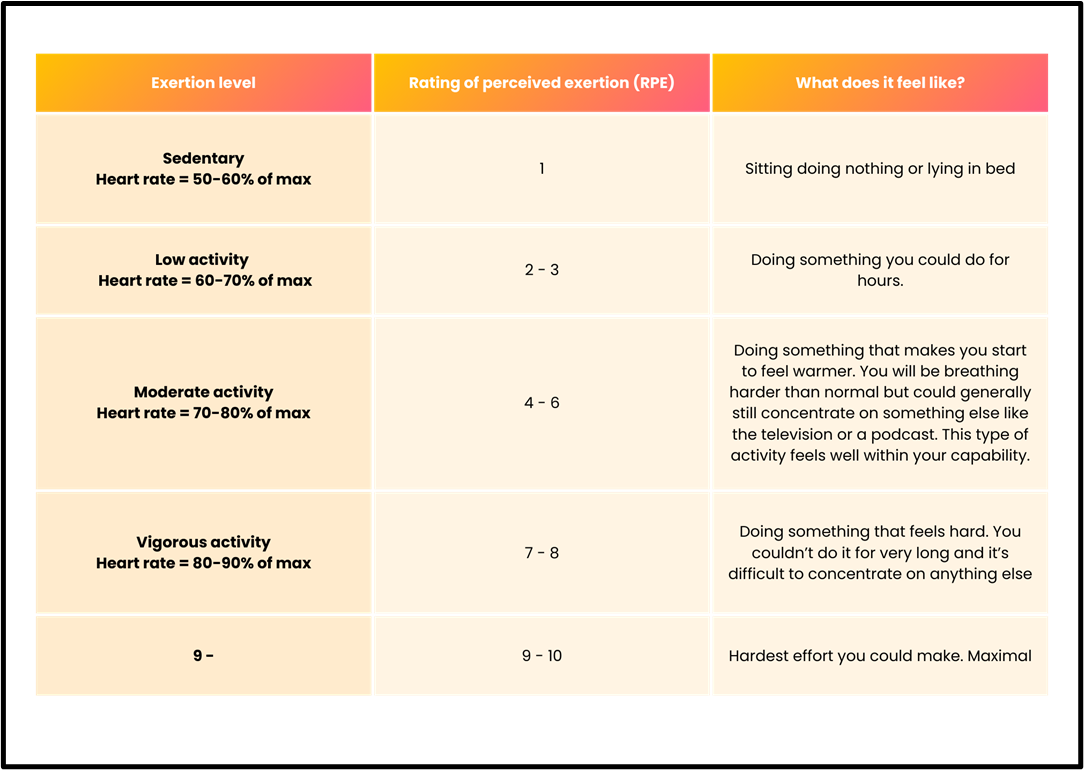
Explanation: What feels like light exercise (RPE 3-4) for one person might feel much harder for someone else. For example, Sir Mo Farah can comfortably run a mile in about 5½ minutes. For him, this would count as light to moderate exercise (RPE3-4), and his heart rate would be around 70% of his maximum, about 140 beats per minute. A healthy 55-year-old man might run or walk a mile in about 14 minutes and also feel it is light to moderate exercise (RPE3-4). His heart rate at this pace would be about 70% of his maximum too, around 120 beats per minute. The key point is that even though they are moving at very different speeds, both people are exercising at a similar intensity level (light to moderate) for their fitness. So it’s not about the pace you do, it’s about how it feels to you.
How to build cardiorespiratory fitness.
1. Reducing sitting time (RPE 1-2):
Reducing the time you spend sitting or lying down is an effective way to build fitness and reduce risk. So, standing up in TV ad breaks, for example, is a good way to start.
Why sit less?
There is high quality evidence that sitting less and moving more has important health benefits. This was first demonstrated in 1953 when it was shown, in a groundbreaking study published in the Lancet, that bus drivers were twice as likely to develop heart disease than bus conductors, because conductors sit less and perform light intensity activity during the day.
Figure 3: Coronary Heart Disease and physical activity at work
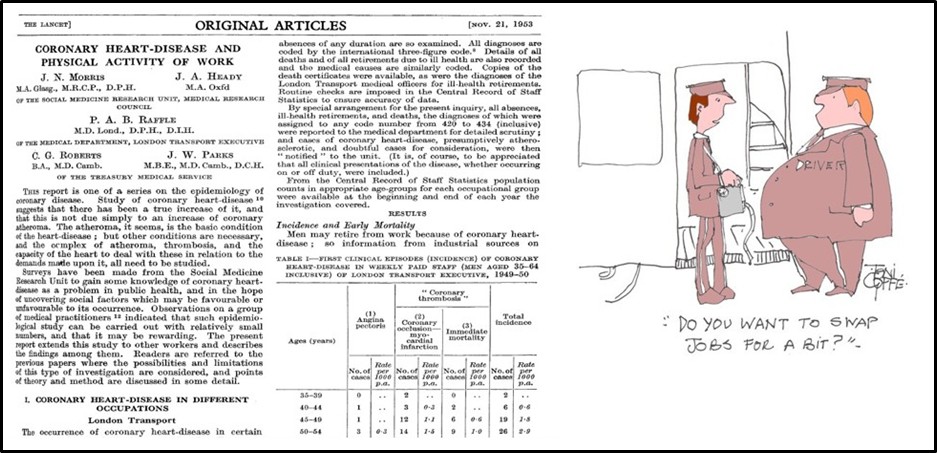
Source: Morris et Al. Coronary Heart disease and physical activity at work. Lancet 1953, Nov, 21.
Explanation: This 1953 landmark study was the first to highlight that bus drivers were twice as likely to develop heart disease than conductors. Since then it has been shown that sitting time (inactivity) is, independently, a very important risk factor for disease. A recent large research study on populations (called an epidemiological study) (figure 4) showed how important daily movement is. For every extra 1,000 steps a person takes each day, their risk of dying from any cause drops by about 15%. Even small actions, like standing up more often, make a difference, even if you only stand for a short time.
Figure 4: The Health Benefits of higher step counts
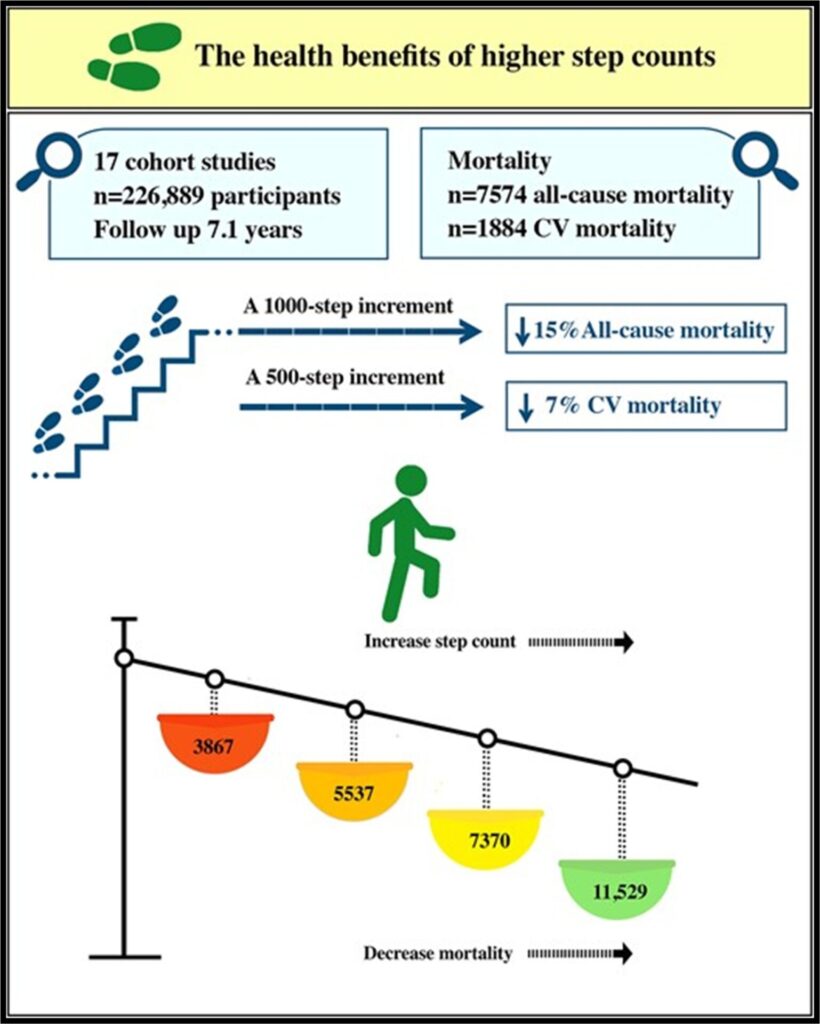
Source: Banach M et al. Eur. J. Prev. Cardiol. Issue 18, December 2023. Pages 1975-85
Explanation: This analysis of multiple large systematic review studies (meta-analysis), including almost 227,000 people, shows that an increase in step count of 1000 steps per day reduces risk of death from any cause by 15%. There is a similar reduction in risk of death from cardiovascular causes.
2. Low intensity activity: RPE: 2-3
Low-intensity activity is exercise done at a comfortable pace that you could keep up for a long time, a few hours for example. Examples include gentle walking, easy cycling on flat ground, gentle housework like dusting or gentle yoga.
When beginning a new exercise routine, starting with low-intensity activities can be a great way to build strength, confidence, and consistency.
Check out our activities pages for examples of activities you might like and try them at low intensities.
How helpful is low intensity activity ?
Risk of death from all causes:
The graph below (figure 5) from a 2022 study published in The Lancet, shows how the risk of death (called the “hazard ratio”) drops as the number of steps per day increases.
Figure 5: Dose-response association between steps per day and death from all causes, by age group
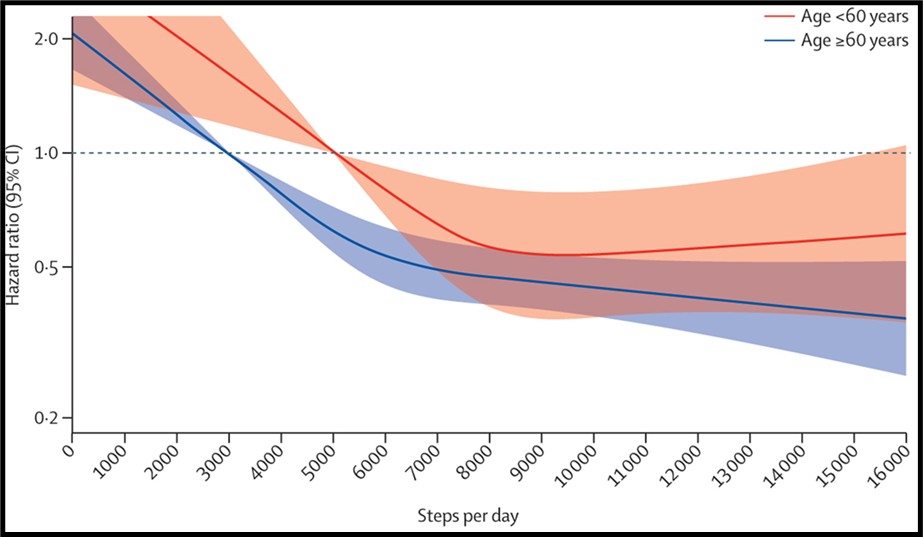
Explanation: This large study, called a meta-analysis, included nearly 50,000 adults. It found that for adults over 60, the best number of steps per day is between 6,000 and 8,000, while for adults under 60, the best range is slightly higher at 8,000 to 10,000 steps per day. However, even lower step counts still have major health benefits. The blue line on the graph represents a man over 60 years old and shows that by increasing his steps from 1,000 to 3,000 per day, he can cut his risk of death by about 50%. Interestingly, this large study also found that walking faster or more intensely (as measured by step rate) did not provide any extra benefit compared with walking at a slower pace. In other words, the total number of steps mattered more for reducing the risk of death than how quickly those steps were taken.
3. Moderate intensity activity: RPE 4-6
Moderate intensity activity is any activity which makes you breathe harder. You should still be able to talk in full sentences, but you would find it difficult to sing.
The Chief Medical Officer, in his 2019 guidelines, recommends that older adults should work towards 150 minutes of moderate activity per week. Examples would include brisk walking, brisk swimming, pushing a lawnmower or dancing — anything in fact which makes you feel you are working at 4-6 out of 10.
4. High intensity or vigorous activity: RPE: 7-8
High-intensity exercise (often called HIIT, or High-Intensity Interval Training) involves short bursts of very energetic activity, followed by periods of rest. It is a time-efficient way to exercise and can bring major health benefits. Examples of HIIT would include HIIT classes in the gym, spinning, aerobics or football.
Because HIIT is quite demanding, it does carry a slightly higher risk of injury and, in rare cases, serious problems such as heart attack or stroke. However, when done correctly and with proper preparation, it can be safe and effective, even for older adults.
High quality research shows that consistent HIIT can improve cardiovascular fitness, improve risk factors for disease, support a healthy metabolism, and reduce the risk of falls.
It’s very important that you build up your fitness and strength before trying HIIT. You may find it helpful to speak with a qualified fitness professional before starting HIIT, just to make sure you are ready for it! Remember the golden rule… start low and build gradually.
_________________________________
Strength (resistance) exercise
The Chief Medical Officer recommends older adults do resistance (strength) exercises at least twice a week. It doesn’t matter where you start, even if it’s only for a minute at a time to begin with, but the important thing is to build up gradually.
What is strength (resistance) exercise?
Strength, or resistance, exercise is any activity where your muscles work against a force. This could be as simple as using your own body weight against gravity, for example, standing up from a chair, doing a small squat, or lifting your heels onto tiptoes in a calf raise. It can also include lifting objects such as weights, a bag of sugar, or a full water bottle. The important thing is that your muscles feel like they are working. If you repeat the movement several times, your muscles will eventually start to feel tired.
You can also build strength through everyday tasks. Take a look at the activities pages to see which activities are especially good for strength, and how to get started.
You should begin with an exercise that feels tiring after about five repetitions, and then build up gradually. It often helps to complete the exercises in sets. A set means repeating an exercise several times, taking a short rest, and then repeating it again.
For example, you could try standing up from a chair without using your arms. Repeat this until you feel tired, take a short break, and then try it again.
Remember: strength improves with practice. Exercises that feel difficult at first will become easier as your muscles adapt.
To keep building strength, you need to gradually increase the challenge. For example, if you can stand up from a chair five times without using your arms this month, aim to do more repetitions next month or carry a small weight as you stand up so your muscles continue to grow stronger.
Muscle: why is it important to build muscle as we get older?
As we get older, our muscles naturally become weaker. This process is called sarcopaenia. On average, older adults have about 40% less muscle than they did when they were younger. This can make everyday activities harder to do. It can make us feel weak, tired and sluggish. It can reduce the speed we can walk and make us more susceptible to falling.
Among people aged 50 to 69 years, about 2% of men and 14% of women have difficulty standing up from a chair without help. By the time people reach 70 to 74 years old, these numbers increase to 7% of men and 25% of women.
The good news is that strength training, also called resistance exercise, can help reverse this process. You are never too old to improve your muscle strength and function, and the benefits can be life changing, even for people with several health conditions.
The advice from the science is clear:
- You are never too old to get stronger
- Those who do the least now have the most to gain by doing more
- You don’t need to lift heavy weights! Simple movements, against the weight of your own body done a couple of times a week can make a real difference.
Is it even possible to build muscle as we get older?
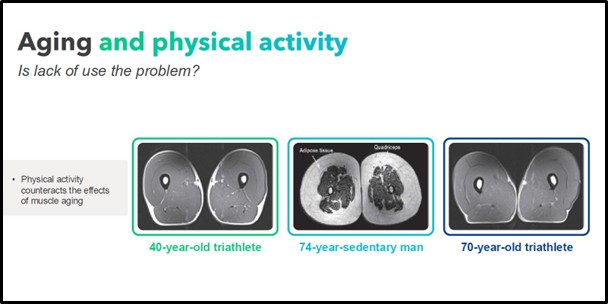
Consider the MRI images below (figure 6). These are cross sectional images of legs. The dark grey is muscle and the light grey is fat. As you will see in this example, a triathlete at 40 years old will have mainly muscle, and only a little fat in his legs. A 70 year old triathlete will have very similar looking legs on MRI scanning to someone 30 years younger! However, the person in the middle, who doesn’t do very much for his leg strength, has much less muscle and much more fat showing on his images.
Figure 6: MRI images of three participants
Source: Wroblewski AP, Amati F, Smiley MA, Goodpaster B, Wright V, Chronic exercise preserves lean muscle mass in masters athletes. Phys Sportsmed. 2011 Sep;39(3): 117-8. doi: 10.3810/psm.2011.09.1933. PMID 202030953.
What do muscles do?
Muscles are the body’s powerhouse. They play an important role in many vital body functions. Strong muscles bring many proven health benefits, including:
- Supporting joints to help us move safely and effectively
- Protecting us against osteoporosis and osteoarthritis
- Lowering the risk of type 2 diabetes by helping the body use insulin and process the sugars you eat more effectively
- Helping to manage high blood pressure, especially in the early stages
- Releasing substances called myokines, which support healthy metabolism throughout the body
- Reducing long-term, low-level inflammation linked to diseases such as heart disease, stroke, and some cancers
- Lowering the risk of dying early from any cause
- Reducing the risk of developing many serious diseases
Building up your muscle strength and the amount of muscle you carry is therefore vitally important, whatever age you are.
What is the disability threshold?
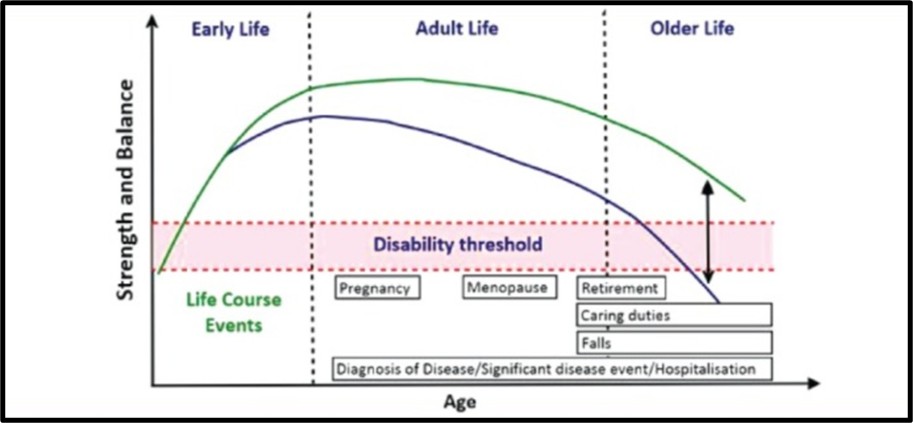
The disability threshold is a measure of body strength and balance above which you can safely maintain your own independence through carrying out routine daily activities.
The study below (figure 7) illustrates the concept of the “disability threshold.”
Figure 7: Strength and balance ability over the life course and potential ages or events that may change the trajectory of decline with aging.
Source: Skelton DA, Mavroeidi A. How do muscle and bone strengthening and balance activities (MBSBA) vary across the life course, and are there particular ages where MBSBA are most important? J Frailty Sarcopenia Falls. 2018 Jun 1;3(2):74-84. doi: 10.22540/JFSF-03-074. PMID: 32300696; PMCID: PMC7155320.
Explanation: As infants, we depend on others for care, and as we grow older, there’s a risk we may become dependent again. (green line-men, blue line-woman). This study concluded that there are key points in life when it is important to do more strength and balance training in order to reach the disability threshold later-or even avoid it altogether. Women, for example, commonly lose strength during pregnancy and around the menopausal years. Both men and women commonly lose strength and balance as they reach retirement and with the onset of medical conditions.
And there’s something about your diet….
While it’s important to fuel all of our activity with enough calories, when we are trying to build our strength, it’s important to make sure we get enough protein in our diet. While this website isn’t directly about nutrition, you will find lots of information about this through the following resource. You can also find out more about this through a dietician or nutritionalist. There may be one at your local GP surgery.
The British Dietetic Association

The British Dietetic Association (BDA) is the professional association and trade union for dietitians in the UK, dedicated to promoting the role of dietitians and improving public health through promoting healthy eating and nutrition.
_________________________________
Balance, stretching and flexibility
The Chief Medical Officer recommends that older adults do exercises which improve balance at least twice a week.
What is balance exercise?
Simple exercises like standing on one leg, standing up with your eyes closed, walking heel to toe or standing on your tiptoes all improve balance.
There are lots of home exercise programmes you could try as well.
Specific activities like yoga and Tai Chi are very good for balance and can be done at home or in a group class setting. Check out our activity pages to find things that might work for you.
Why is balance exercise important?
As we get older, the parts of our body that help us stay balanced also age and may not work as well as they used to. These include our eyesight, the balance systems in our ears, and the balance sensors around our joints.
At the same time, many people lose some muscle strength and control, or experience joint pain and long-term health conditions. These changes can make us less steady on our feet and increase the risk of falling.
Falls are the main cause of injury-related deaths in people over 65. They can also lead to serious injuries, hospital stays, and a loss of independence.
When we start to feel less steady, we might become afraid of falling — this is called “fear of falling.” Sadly, this fear can actually increase the chance of falling, because it can make us less confident, less active, and even less social. But being less active makes our muscles weaker, which again raises the risk of falling.
That’s why it’s so important to prevent falls by doing strength and balance activities. These help us stay healthy, independent, and confident.
There’s strong evidence that physical activity lowers the risk of falling as we age. Exercises that focus on balance and functional movements (activities that copy everyday actions like standing up, walking, or carrying things) are especially helpful.
The good news is that with regular balance exercises, you can make real improvements quite quickly!
_________________________________
The Moving Medicine Star System
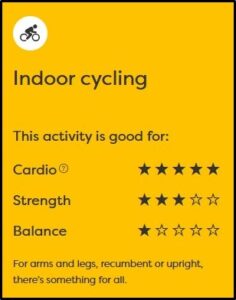
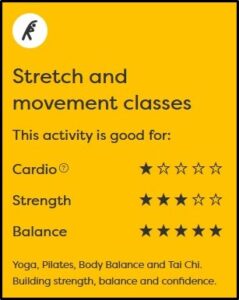
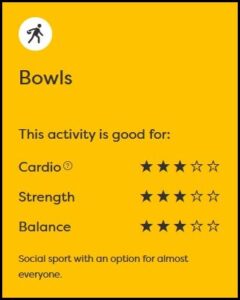
Some activities focus more on one type of movement than others. Each of our activities has a star rating which gives you an idea of how good it is for cardio, strength and balance.
In the example below; spinning on an indoor bike scores highly for cardio, medium score for strength, and has a lower score for balance.
Yoga, on the other hand, gets a high score for balance, a low score for cardio.
The good news is, many activities will involve cardio, strength and balance movement all at once. So we can incorporate everything in one fell swoop!
For example, bowls gives you a mix of cardio, strength, and balance activity.
Visit our activities pages to understand this better.
We’ve also given each symptom and condition a star rating to help you understand which type of movement is most helpful for you and your medical conditions.
For instance, if you struggle with falling or have a fear of falling, you’ll benefit most from strength and balance activities.

If you have diabetes, cardio and strength movement are most helpful, while balance is less important.

This way, you can find out which activities will work best for you.