Introducing you to some of the most important and transformative academic studies that prove the effectiveness of exercise in the prevention and treatment of multiple long-term conditions.
How does moving more make life better?
For almost everybody, increasing activity is a good thing. This is even true for people who are living with symptoms of a number of health conditions, or who are very limited in what they are able to do due to their health. Check out the symptoms and conditions pages to find the benefits for you.
Staying active allows us to live better for longer
When we keep moving, we’re less likely to develop medical conditions. That means fewer problems like pain, fatigue, falling, needing hospital care or support with daily tasks. The more active we are, the better our lives can be as we get older.
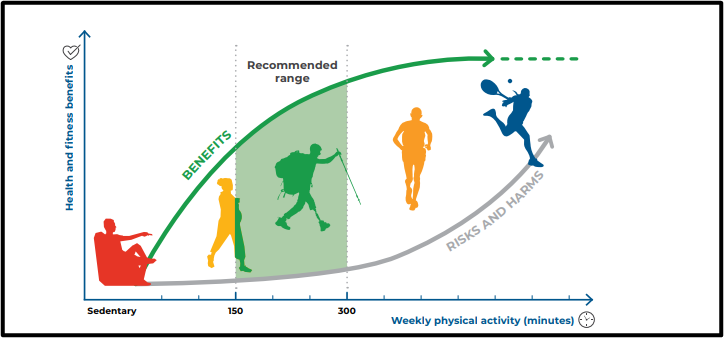
Figure 1: Dose:response curve showing relationship between minutes of activity and health benefits
Source: Image adapted from WHO Physical Activity Guidelines.
This graph shows that there is a rapid increase in benefits for people who are very inactive, long before they reach the recommended activity levels (of 150 minutes per week). So even a little more activity can make a big difference.
Activity helps us stay independent
When we stay active, we keep strong. That means we can do more for ourselves as we get older, and rely less on others for help.
Being more active helps us maintain our independence. It prevents frailty and strengthens our ability to manage the daily activities we need and enjoy, like moving around more easily, completing household tasks, carrying shopping, or climbing stairs.
The more active we are, the more likely we are to keep doing these things. Research shows that staying active is one of the most effective ways to reduce our risk of falling. Fewer falls mean fewer injuries and a lower chance of ending up in hospital.
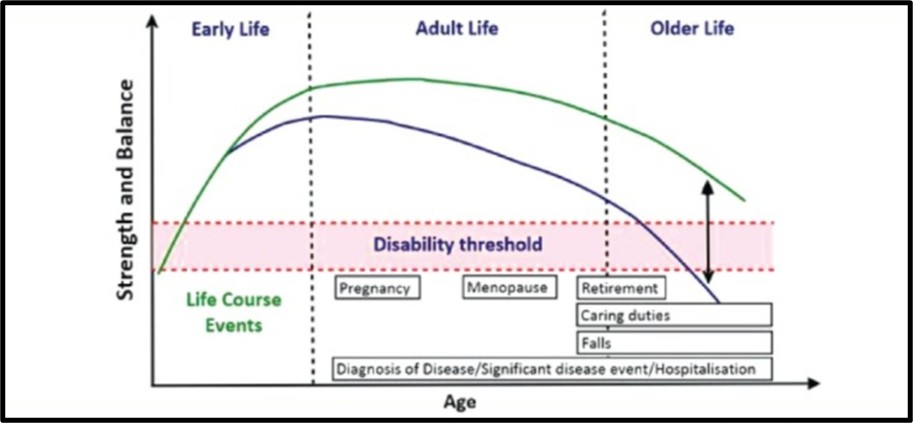
The study below shows the concept of the “disability threshold.”The disability threshold” is a measure of body strength and balance above which you can safely maintain your own independence through carrying out routine daily activities.
Figure 2: Strength and balance ability over the life course and potential ages or events that may change the trajectory of decline with aging. The green line represents men, while the blue line represents women.
Source: Skelton DA, Mavroeidi A. How do muscle and bone strengthening and balance activities (MBSBA) vary across the life course, and are there particular ages where MBSBA are most important? J Frailty Sarcopenia Falls. 2018 Jun 1;3(2):74-84. doi: 10.22540/JFSF-03-074. PMID: 32300696; PMCID: PMC7155320.
Explanation of graph: As infants, we depend on others for care, and as we grow older, there’s a risk we may become dependent again. (green line-men, blue line-woman). This study concluded that there are key points in life when it is important to do more strength and balance training in order to push these lines upwards and reach the disability threshold later-or even avoid it altogether. Women, for example, commonly lose strength during pregnancy and around the menopausal years. Both men and women commonly lose strength and balance as they reach retirement and with the onset of medical conditions.
Keeps us feeling more energetic
The more we move, the more energy we have and the less tired we feel. Being active also helps us sleep better, so we wake up feeling more refreshed.
Being more active improves the efficiency of our cardiovascular system, helping oxygen and nutrients circulate more effectively throughout our bodies. Activity increases the number of mitochondria — the ‘powerhouses’ of our cells — giving us more energy. Our muscles grow stronger, making everyday tasks easier to manage. Staying active also boosts our mood and enhances our overall wellbeing by regulating stress hormones and increasing the release of ‘feel-good’ chemicals. It lowers inflammation in our bodies and improves sleep quality, both of which help reduce fatigue and increase our energy levels.
In people living with chronic fatigue syndrome/ME and post-COVID syndrome, there is a risk of post-exertional malaise (PEM). This is where symptoms can get much worse after even a small increase in physical, mental or emotional effort, causing a crash of energy. If you are living with one of these conditions, please talk to a medical professional to discuss the latest guidance around how to safely become more active.
Keep us feeling happier
When we’re active, our brain releases “feel-good” chemicals, like endorphins. These lift our mood, ease pain and tiredness, and help us sleep and feel better.
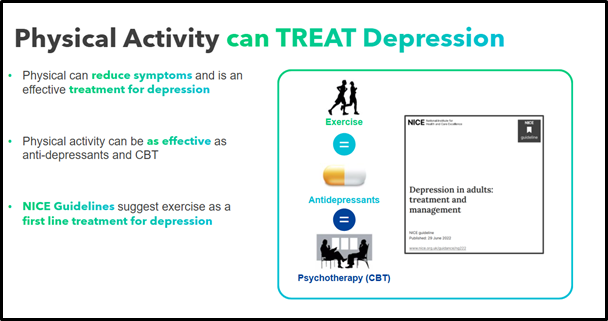
When we move more, our brains release chemicals that help improve our mood and reduce feelings of anxiety. Recent evidence shows that structured exercise can be an effective treatment for depression in both people who do have LTCs and those who don’t, and the National Institute for Health and Care Excellence (NICE) recommends physical activity as a treatment for depression.
NICE concluded that group physical activity(cardio activity for 60 minutes 3x a week) should be considered as first line treatment for less severe depression
Figure 3: Summary of NICE guidelines in mild to moderate depression
Source: Schuch et al. J Affect Disord. 2016; Cooney et al. Cochrane Database of Systematic Reviews 2013; Hallgren Br J Psychiatry. 2016; Recchia et al. B J Sports Med 2022.
Physical activity lowers the levels of stress hormones, can relax our muscles, reduce pain and other health symptoms over time. It also improves the quality of our sleep. Being active can help us feel more confident to do things, even if at times it can feel hard, meaning we are more likely to do the things we enjoy, or spend time with other people. Over time, this all helps us feel more energetic, less tired, and can help to improve our general wellbeing and quality of life.
Lowers our risk of disease and can help reduce need for medication
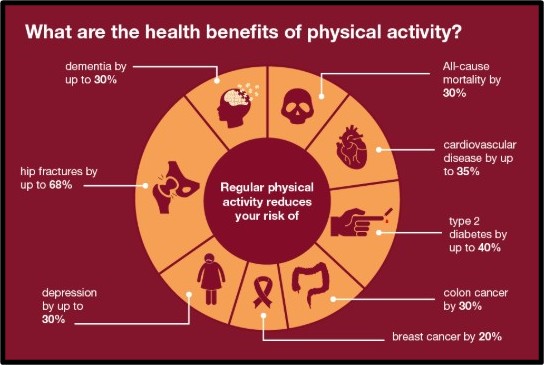
Being active cuts our chances of getting many illnesses. For example, it can lower the risk of type 2 diabetes and high blood pressure by about half, heart disease by over a third, stroke by nearly a third, some cancers, joint, and back pain by about a quarter.
When we’re more active, our hearts get stronger. Our blood vessels become more flexible and better at supplying our muscles and organs with oxygen. Our blood pressure stays lower, and our risk of heart disease or stroke goes down. Our bodies process sugars more efficiently, which lowers our chances of developing Type 2 diabetes. We’re also more likely to have lower levels of ‘bad fats’ in our blood, like LDL (low-density lipoprotein) and triglycerides, and we can reduce the harmful layer of fat around our middles. Our inflammation levels decrease, which lowers our risk of some long-term conditions, including cancer. Staying active keeps our muscles and bones strong and helps with our balance, so we’re less likely to fall or hurt ourselves. It also helps us sleep better, boosts our mood, and improves our overall quality of life
Figure 4: health benefits of physical activity
Source: https://www.gov.uk/government/publications/physical-activity-applying-all-our-health
Reducing the impact of disease
Being active is helpful even if you already have health conditions.
It can lower the chance of some cancers, like breast and bowel cancer, coming back. It can also reduce the risk of having another heart attack or stroke, and may even mean needing less medicine for depression.
Regular activity can also lower the risk of developing additional health problems (sometimes called multi-morbidity).
When we’re more active, stronger, and more physically fit, our hearts, lungs, muscles, and bodies can better cope with long-term health conditions. We may also notice improvements in symptoms such as shortness of breath with COPD or joint stiffness and pain. Our bodies use sugar more efficiently, which helps control blood sugar if we have diabetes or are at risk of developing it. Staying active helps prevent dementia and can also slow the worsening of memory problems.
Being more active helps us tolerate treatments better, reduces hospital admissions, and can shorten the amount of time we spend in hospital. It helps us stay independent for longer and less likely to need help from others.
Regular activity also improves our quality of life, mood, and sleep. Evidence shows that being active enhances our ability to do more and improves health-related quality of life across many long-term conditions.
Figure 5: Evidence mapping bubble plot of exercise-based interventions for long-term conditions
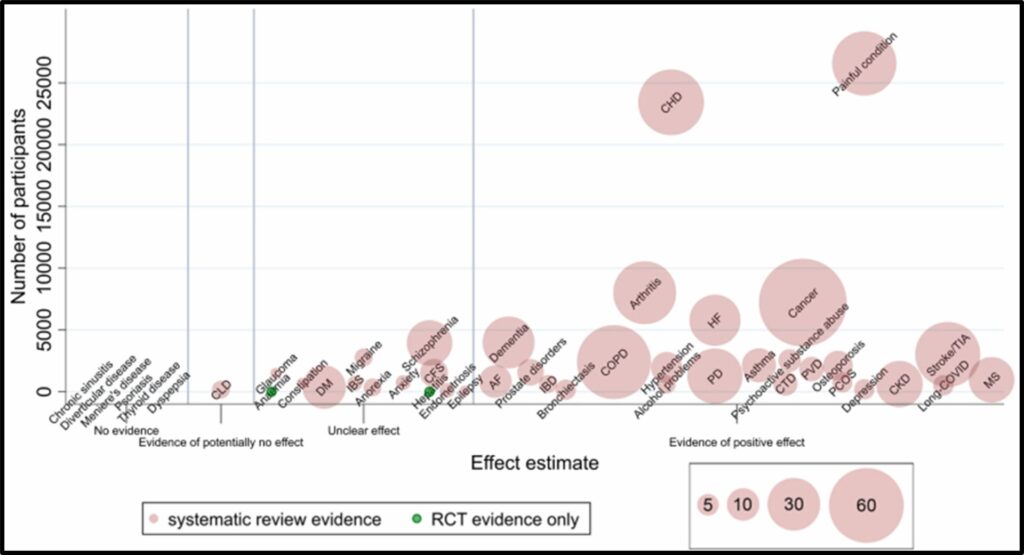
Source: Dibben G et Al. Evidence for exercise-based interventions across 45 long term conditions. eClinical medicine. Lancet group. Volume 72102599June 2024
Evidence mapping bubble plot of exercise-based interventions for long-term conditions (LTCs). vertical-axis: number of participants included in the selected systematic review. horizontal-axis: categorisation of exercise intervention effect.
- No evidence: no eligible trails identified
- Evidence of potentially no effect: all outcomes showed no effect
- Unclear effect: conflicting results between trials
- Evidence of positive effect: all/most outcomes showed positive effect
NB: the positioning of bubbles does not denote effect size. (RCT, randomised controlled trial; CLD, chronic liver disease; DM, diabetes mellitus; IBS, irritable bowel syndrome; CFS, chronic fatigue syndrome; AF, atrial fibrillation; IBD, inflammatory bowel disease; COPD, chronic obstructive pulmonary disease; CHD, coronary heart disease; PD, Parkinson’s disease; CTD, connective tissue disease; PVD, peripheral vascular disease; PCOS, polycystic ovarian syndrome; CKD, chronic kidney disease; TIA, transient ischaemic attack; MS, multiple sclerosis).
Explanation of graph: The graph above is taken from an an overview of systematic reviews. It illustrates the effect of activity-based interventions across 45 different conditions. Those conditions on the right of the graph have the strongest evidence for positive effect. The bubble size denotes the number of systematic reviews used in the overview for each condition, which is an indicator of the strength of the current evidence for each condition.
You can find lots more about the specific benefits of exercise in the conditions and symptoms pages, but there is some extra information summarising the most up to date evidence on the Moving Medicine professional site too if you are interested.