What does ‘start at a comfortable level and build gradually ‘ actually mean?
Start at a comfortable level and build gradually is the golden rule for safe, effective, and lasting exercise. Starting slow means beginning at the level you’re at now — not where you were five months or five years ago.
When we’ve had a break from being active, it’s easy to want to jump straight back to what we used to do. But our bodies often remind us that we’re not quite there yet, and that can feel frustrating or discouraging.
It’s absolutely fine to aim to get back to that level — just remember that the fastest and safest way to do it is by building up gradually.
So, it’s about being realistic and listening to your body. For example, if you have not exercised recently, starting low might mean doing just a few repetitions of an activity, using light weights, or exercising for a shorter time, closer to what you were doing yesterday and the day before.
Building slowly means increasing the challenge gradually. This could be adding one or two extra repetitions of an exercise, lifting slightly heavier weights or walking a little further or faster as your strength and confidence improve. Progress should be steady, not rushed, to reduce the risk of injury and to make sure the change lasts.
There are different ways to measure where you are starting from. You might notice how quickly you get tired, how many times you can repeat an exercise, or how much weight you can lift comfortably. Just thinking about what you did yesterday, or what you do on an average day at the moment will give you a realistic starting point. Start there, try and repeat every day for a week before building up slowly week by week.
Example: Walking
Think about how far you walked yesterday. You can measure this in different ways. The step count function on your phone or smartwatch can give you an objective number, or you can simply picture where you went and how much you walked.
Use this point as your starting level and build on it gradually. For example, if you walked 2,000 steps yesterday (around one mile), aim to repeat that most days for a week. Once you can do this comfortably, increase your daily steps by about 200 and keep that up for another week.
By continuing to add small increases each week, your walking distance will grow steadily. In just three months, this method could take you from 2,000 steps a day to almost 3 miles a day!
This steady approach is much less uncomfortable, helps your body adapt safely, reduces the risk of injury, and makes it easier to keep the habit going long-term.
Example: Strength
How many times did you get in and out of a chair yesterday? About 10? About 20? Did you always have to use your arms to help you? If it was 20 times yesterday, start there. So once or twice a day when you get up, sit straight back down again and do it a second time.
Build this up over several months until it feels easier before moving on to something else. Perhaps add a shoulder press or two between your sit to stand exercise, or maybe a biceps curl. It doesn’t matter what, just try and gradually increase the challenge.
Avoid the boom and bust
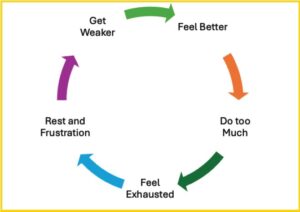
It’s very important to avoid the ‘boom and bust’ cycle of exercise where we might end up doing lots more than usual on a good day and then feel too exhausted to do much for a few days. It’s better to stop before we have done too much, but try and sustain this every day.
Figure 1: Boom and bust cycle
Good days and bad days
As you start a regular exercise routine, there will be days when your body feels sore and you feel tired. This is normal, so don’t worry. Everyone has bad days. Just try to do something, even if it’s only a little.