Many people find it helpful and motivating to track their movement. This allows you to look back to see how you’re improving, follow your progress, or even decide on a good place to start. Modern technology can support your fitness journey.
You don’t need an expensive smartwatch to do this. There are many mobile phone apps that can track your steps and log your activity really well if you keep them with you all the time. Lots of these apps are free to use and there are also subscription versions which will give you more information and data.
Step counting
Most mobile phones will measure your step count if you carry them around with you. Most will also allow you to track your step count over days, weeks, months or years.
Pace-Up is a 12 week walking programme which has been proven to help increase walking and health in the long term. This uses your step count reading to help you build and progress your activity.
The problem with step counters is that they don’t measure things you are doing when you are standing or sitting. So if, for example, you choose to exercise on a static bike, do chair based exercises or do a yoga class. To measure that you would need something that measures your heart rate, like a smart watch.
Using smart watches
Smartwatches are more than just digital watches. They are small wearable devices that can help you keep track of your health, fitness, and daily activities. Many smartwatches can monitor your heart rate, count your steps, measure the distance you walk, swim, cycle or run, and even remind you to stand up if you have been sitting for too long. Some models can check your sleep patterns, measure blood oxygen levels, or record your workouts in detail.
For people who want to stay active, smartwatches can be a useful tool. They give instant feedback so you can see how much exercise you are doing each day and whether you are meeting your goals. For example, if your aim is to walk 10,000 steps a day, your smartwatch can help you track your progress in real time.
Some people find the heart rate data a smart watch can provide useful. Your heart rate does generally correlate with exercise intensity, especially for measuring cardio movement. So the higher the heart rate, the more intensely you are working. If you are taking medications, especially beta-blockers, this data can become confusing and misleading and so it’s probably best to stick with a rating of perceived exertion (RPE) rather than monitoring your heart rate.
Estimating maximum heart rate
If you want to use heart rate data to monitor your activity, you can estimate your maximum heart rate using the following formula:
206.9-(0.67xage)
So if you were 70 years old, your maximum heart rate (on average) will be 206.9-(0.67×70)=160 beats per minute
You can estimate your resting heart rate by checking your heart rate when you have just woken up in the morning before you get out of bed.
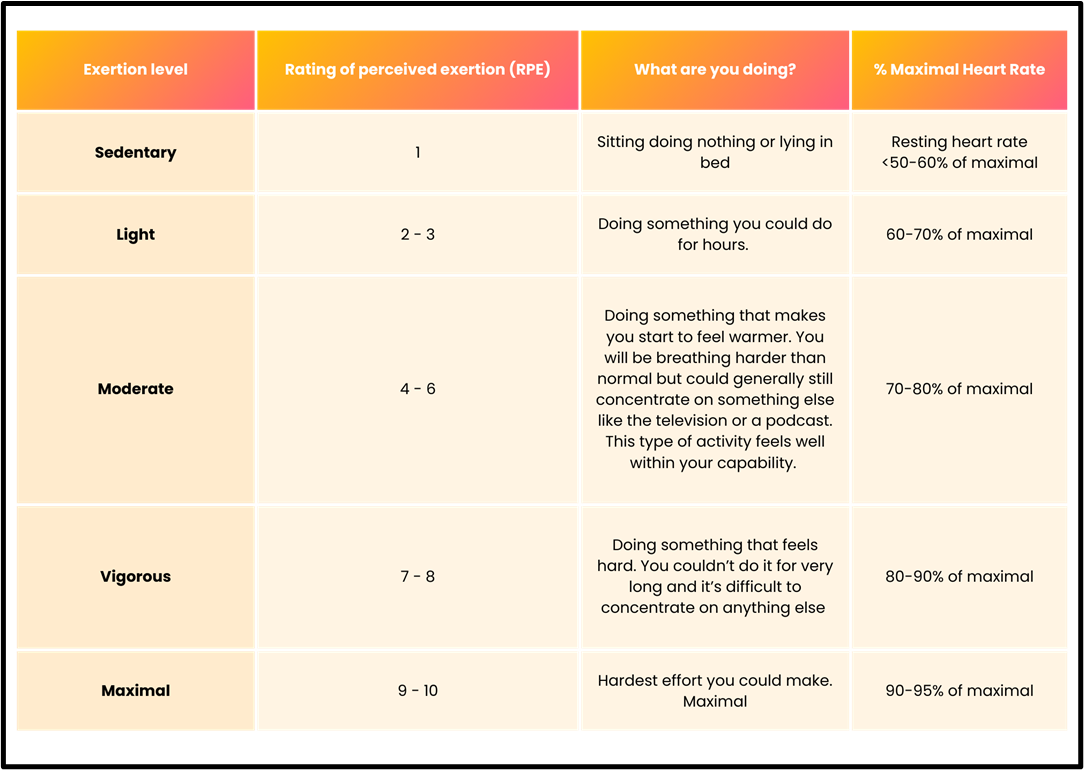
You can use both of these two measurements to understand how hard you are working in any given activity.
Table: Comparison between % of maximum heart rate and rating of perceived exertion
Smartwatches can also connect to your phone, letting you receive calls, messages, or calendar reminders without taking your phone out of your pocket. They can also pay by card if you want them to! For older adults, some smartwatches have safety features such as fall detection and emergency alerts, which can provide extra peace of mind.
By combining health monitoring with everyday convenience, smartwatches can support both fitness and wellbeing.